Friday, August 5, 2022

Theyyam

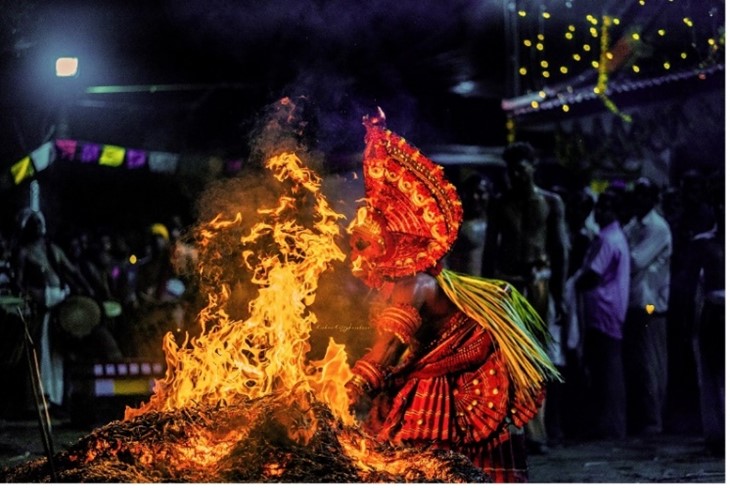
                    Theyyam is a popular ritual form of dance worship in Kerala and Karnataka. Theyyam consists of thousand-year-old traditions, rituals and customs. The people of these states consider Theyyam itself as a channel to a god and they thus seek blessings from Theyyam. There are about 456 types of Theyyam. Theyyam is performed by males, except the Devakoothu theyyam; the Devakoothu is the only Theyyam ritual performed by women. Devakoothu is performed only in the Thekkumbad Kulom temple. In Kerala, Theyyam is performed predominantly in the North Malabar region. A similar custom is followed in the Mangalore region of neighboring Karnataka known as Bhuta Kola.


               Theyyam has a long history. There are approximately 400 types of Theyyam, including Vettakkorumakan, Vishnumoorthy Theyyam, Muchilot Bhagavathi and Sree Muthappan. According to K.K.N.Kurup, it can be said that all the prominent characteristics of primitive, tribal, religious worship had widened the stream of Theyyam, where even the followers of Islam are associated with the cult in its functional aspect and made it a deep-rooted folk religion of millions. For instance, Bhagavathi, the mother goddess had and still has an important place in Theyyam. Besides this, the practices like spirit-worship, ancestor-worship, hero-worship, tree-worship, animal worship, serpent-worship, the worship of the goddesses of disease and the worship of Gramadevata (Village-Deity) are included in the mainstream of the Theyyam. Along with these gods and goddesses there exist innumerable folk gods and goddesses. Most of these goddesses are known as Bhagavathy.

          Different branches of mainstream Hindu religion such as Shaktism, Vaishnavism and Shaivism now dominate Theyyam. However, the forms of propitiation and other rituals are continuations of a very ancient tradition. In several cult-centers, blood offering is seen, despite being forbidden in Buddhism, Jainism and Brahminism. In such centers, separate places outside the precincts of the shrine are selected for blood offering and for the preparation of the traditional Kalam (Square made for this sacrifice occasion) known as Vadakkan Vathil. The Theyyam deities propitiated through cock-sacrifice will not enter such shrines. This religious cockfight over blood sacrifice, which does also include the cockfight as a blood sacrifice, is a prime example of "cultural synthesis of 'little' and 'great' cultures".

          On account of the supposedly late revival of the Vaishnavism movement in Kerala, it does not have a deep impact on Theyyam . Only a few deities are available under this category. Two major Theyyam deities of Vaishnavism are Vishnumoorthi and Daivathar. Vaishnavism was very popular in the Tuluva region in the 13th century when it came under the rule of Vishnuvardhana of the Hoysala dynasty. He was a great champion of Vaishnavism. Most probably he was initially deified as Vishnumoorthi and incorporated into the Bhoota cult of the Tuluvas and then further incorporated as a prominent folk deity into the Theyyam as well. To some, the legend of Vishnumoorthi symbolizes the god's migration from Mangalore to Kolathunadu.

          All other categories of Theyyam deities can be classified under Shaivism or Shaktism. Even spirits, ancestors, heroes, and animals are deified and included in those categories. Briefly, Theyyam provides a good example for the religious evolution of, and the subsequent different stages in modern Hinduism, with the overall understanding that within Hindu syncretism lay propitiation as ancient practices and rituals of ancient worship intended for the blessings of the supernatural not unlike, in Indus Valley and other ancient civilizations, mother goddess had been invoked for fertility and prosperity.


                  Out of devotion, ruling clans established their own shrines and Kavus for Theyyam deities where non-sattvic rituals and customs are observed. The goddesses like Rakteshwari, Chamundi, Someshwari, Kurathi, and the gods like Vishnumoorthi are propitiated in these household shrines. There, the Theyyam dancers appear during the annual festivals of gods and goddesses. The rituals in such shrines are different from those of the Brahmanical temples. The impact of this cultural fusion could be traced to the social organization based on the caste system and in the agrarian relations. The inviting of Brahmin Thanthri to consecrate the idols of Kavu is a recent development.

         The dance or invocation is generally performed in front of the village shrine. It is also performed in the houses as ancestor-worship with elaborate rites and rituals. There is no stage or curtain or other such arrangements for the performance. The devotees would be standing or some of them would be sitting on a sacred tree in front of the shrine. In short, it is an open theatre. Performance of a particular deity according to its significance and hierarchy in the shrine continues for 12 to 24 hours with intervals. The chief dancer who propitiates the central deity of the shrine must reside in the rituals. Further, after the sun sets, this dancer would not eat anything for the remainder of that day. His make-up is done by specialists and other dancers. The first part of the performance is usually known as Vellattam or Thottam. It is performed without proper make-up or any decorative costume. Only a small, red headdress is worn on this occasion.


                The dancer along with the drummers recites the ritual song, which describes the myths and legends, of the deity of the shrine or the folk deity to be propitiated. This is accompanied by the playing of folk musical instruments. After finishing this primary ritualistic part of the invocation, the dancer returns to the green room. Again, after a short interval, he appears with proper make-up and costumes. There are different patterns of face painting. Some of these patterns are called vairadelam, kattaram, kozhipuspam, kottumpurikam, and prakkezhuthu. Mostly primary and secondary colors are applied with contrast for face painting. It helps in effecting certain stylization in the dances. Then the dancer comes in front of the shrine and gradually "metamorphoses" into the deity of the shrine. The performance signifies the transitional inversion, reversal, and elevation of status denoting the anti-structural homogeneity of Theyyam. He, after observation of certain rituals places the head-dress on his head and starts dancing. In the background, folk musical instruments like chenda, tudi, kuzhal and veekni are played in a certain rhythm. All the dancers take a shield and kadthala (sword) in their hands as continuation of the weapons. Then the dancer circumambulates the shrine, runs in the courtyard and continues dancing there. The Theyyam dance has different steps known as Kalasam. Each Kalasam is repeated systematically from the first to the eighth step of footwork. A performance is a combination of playing of musical instruments, vocal recitations, dance, and peculiar makeup and costumes. The Kathivanoor Veeran Theyyam is one of the famous theyyam in Kerala.

          There are about 456 types of Theyyam, among which 112 are famous. Some of the famous Theyyams are:

Vishnumoorthy Theyyam


                It is the most popular Vaishnava Theyyam. This theyyam narrates and performs the story of Hiranyakashipu's death by the Lord Vishnu in his avatar of Narasimham.

Sree Muthappan Theyyam

          Muthappan theyyam consists of two divine figures— the Thiruvappana or Valiya Muthapan (Vishnu) and the Vellatom or Cheriya Muthapan (Shiva). Muthappan Theyyam is different from other theyyams as it is performed all around the year.

Padikutti Amma

          The Padikuttiyamma is believed to be the mother of Muthapan. The Padikutti Amma Theyyam is performed in the Palaprath Temple in Kodallur near Parassini Kadavu in the Meenam ( a Malayalam month).

Gulikan

          Gulikan represents Yama, the Hindu god of death, called Yama. The Benkanakavu in Nileshwar is the most famous temple dedicated to Gulikan.

Padamadakki Bhagavathy

          The legend behind the Padamadakki Bhagavathy theyyam is that the Nileswar Raja prayed to the goddess for help from the invading army from Karnataka and Devi sent Padamadakki Bhagavathy for help. Upon seeing the Padamadakki Bhagavathy, the attacking army became unconscious and thus the war was averted.


Kathivanur Veeran

The Kathivanur Veeran theyyam is performed in the memory of the great warrior Mandhappan.

Manakkott Amma

          Manakkott Amma Theyyam is performed in the Vairajathan Temple in Nileshwar. The Manakott was a woman born in a Nair family. She opposed the caste system that existed at that time. When she broke a caste rule, she was killed by the head of the family. She was pregnant at that time. Her murder caused a lot of problems in their family and was finally destroyed. Later she emerged as a goddess.

Chamundi

          Chamundi theyyam is majorly, of three types, namely, Madayil Chamundi Rakta Chamundi Kundorra Chamundi.

Madayil Chamundi

          Chamundi is a form of Durga Bhagavathy to slay the demons Chandan and Mundan. The same goddess is also known as Raktachamundi as she kills the demon Raktha Bijasura. Known as Kundora Chamundi, Kundadi Chamundi and Kundoor Chamundi, this goddess is the image of Kali who killed Darikasura. This theyyam is built by Velanmar.


               Theyyam holds such high religious importance, that during the performance, even the higher caste members pay reverence to the performers in order to please the deity. Such social hierarchal reversal is very uncommon among the religious-minded population of India.

Wednesday, August 3, 2022

THE KUMARAN ASAN NATIONAL INSTITUTE OF CULTURE


KUMARAN ASAN

          N. Kumaran Asan was an Indian social reformer, philosopher and poet of Malayalam literature. He is known to have initiated a revolution in Malayalam poetry during the first quarter of the 20th century, transforming it from the metaphysical to the lyrical and his poetry is characterized by its moral and spiritual content, poetic concentration and dramatic contextualization. He is one of the triumvirate poets of Kerala and a disciple of Sree Narayana Guru.


                          Asan was born on April 12, 1873, in Kayikkara village, Chirayinkeezhu taluk, Anchuthengu Grama Panchayat in Travancore. Narayana Guru's influence led Asan to spiritual pursuits. In 1895, he moved to Bangalore and studied for law, staying with Padmanabhan Palpu. He stayed there only until 1898 as Palpu went to England and a plague epidemic spread over Bangalore and Asan spent the next few months in Madras before proceeding to Calcutta to continue his Sanskrit studies. At Calcutta, he studied at Tarka sastra at the Central Hindu College, studying English simultaneously and got involved with the Indian Renaissance, but his stay was again cut short due to plague epidemic.

          He returned to Aruvippuram in 1900. Later he moved to Thonnakkal, a village in the periphery of Thiruvananthapuram, where he settled with his wife. On January 16, 1924, he died by drowning, when Redeemer, the boat he was traveling capsized in River Pallana. His body was recovered after two days and the place where his mortal remains were cremated is known as Kumarakodi.

          In 1958, when Joseph Mundassery was the Minister of Education, the Government of Kerala acquired Asan's house in Thonnakkal and established the Kumaran Asan National Institute of Culture as a memorial for the poet, the first instance in Kerala history when the government took over a poet's property to convert it into a memorial. It houses an archive, a museum and a publications division. Asan Memorial Association, a Chennai-based organization, has built a memorial at Kayikkara, the birthplace of the poet. They have also instituted an annual award, Asan Smaraka Kavitha Puraskaram, for recognising excellence in Malayalam poetry. The award carries a cash prize of ₹30,000 and Sugathakumari, O. N. V. Kurup, K. Ayyappa Panicker and K. Satchidanandan are some of the recipients of the award. Asan Memorial Senior Secondary School is a CBSE affiliated higher secondary school run by Asan Memorial Association. The India Post issued a commemorative postage stamp depicting Asan's portrait in 1973, in connection with his birth centenary.


THE KUMARAN ASAN NATIONAL INSTITUTE OF CULTURE

            The Kumaran Asan National Institute of Culture, situated at Thonnakal, Thiruvananthapuram, carries the memories of the great poet. It is the first memorial dedicated by the Government of Kerala to a poet. Prof. Joseph Mundassery, the then Education Minister, laid the foundation stone at the birthplace of the poet in 1958. A committee appointed by the Government carries out the administration of the institute. Exceptional personalities in the field of literature, culture, social work and the like are included in the committee. The institute was bestowed with national status in the year 1999. Along with the monument, the home in which Asan lived is also protected here.


                  Spread over three acres of land is a beautiful garden containing rare medicinal plants maintained under the supervision of distinguished sculptor Kanayi Kunjiraman. The Freedom Gate and the four sculptures being created by Kanayi are the major attractions in the garden. We can also find Mural Paintings in the memorial. Mural Painting is one of the oldest forms of artistic expression.


                           Every year hundreds of tourists and scholars from different walks of life visit this national institute of culture. In the serene atmosphere of the institute the house in which the poet lived is preserved and exhibited without any change. A museum containing the belongings of the poet along with the manuscripts of his renowned works recites the life and development of the bard. Another museum with the largest collection of mural paintings is a special attraction of the institute. For the benefit of students and scholars a village lending library, a children's library, a research center approved by the University of Kerala for language and literature, culture and history, a computer institute, a publishing and sales division etc. are functioning here. The institute has a conference hall and all facilities to meet the requirements of tourists visiting the place.                                                                                           

                              Every year, the institute organizes various programmes of which the Jayanthi celebration conducted in the second week of April, the Asan National Festival conducted in the last week of December and first week of January are the most popular events. 'Vivekodayam' quarterly is the mouthpiece of the institute. The sculptors and paintings that we see in the memorial are the instances taken from Asan’s works. The memorial, in this way, is the visual enactment of Asan’s masterpieces. The handwriting of Asan is also preserved here along with the honorary ‘pattum valayum’ which he received from the prince of Wales when he was declared as ‘Mahakavi’.


                       Many cultural programmes are hosted in the memorial, not only national but also International, and many people from different countries comes together to share their culture and learn ours.

            History is the study of past events. We refer to the past when comparing it with the present times and deduce the changes that have taken place. These actions of the past also shape our future actions. Therefore, history plays a vital role in preparing us for the future. History is such an important part of our everyday lives. Not only because there are certain past events and occurrence’s that shaped our present world, but also since humanity tends to go through the same challenges repeatedly. The only difference is that people learn from what has already happened and develop better problem-solving mechanisms.

          When you read the stories of past individuals and situations, you put yourself in a position to question your own moral sense, improve it so that it can face the real world around you. There are people who overcame adversity and surmounted several obstacles in the past with very minimum resources. We can draw inspiration from such people and imitate their strength in solving the challenges that face us today. It’s always nice to know that the problems that we face are not unique, or that some people faced even greater problems but still managed to succeed.

          It’s important to know where we came from, and the journey that our ancestors travelled in search of a new home. Cultivating a sense of identity makes us appreciate who we are and use our diversity and uniqueness to build a better society. The future generations will need to know about those who came before them and influenced the world in one way or another. We study history so that we can pass on stories to the next generation.

          Culture is what a society lives on. Each society can see its culture reflected in its language, folktales, music, literature, and even in the way it raises its people. Each culture also has its own symbols. Culture has a host of sociological and economic values. It is intrinsic in gaining prosperity, learning, and individual and societal betterment. Participation in the cultural activities of their community brings an individual a host of personal benefits. Such activities can provide an experience to the individual that is always deeply moving- it may be unsettling to some, delightful to a few, and inspiring to others, but its impact is always deep, wondrous, and great.


                                It creates a sense of belonging that few other activities will bring. It is only by participating in a culture that an individual can forge an identity of their own; instead of completely merging with the homogeneous society that globalization is constantly threatening us with, an individual is able to create a unique niche for themselves. The culture of a region acts as a great tourist attraction. Cultural events draw tourists from all over the world eager to share in a unique cultural experience.

          Culture is the glue that brings about social cohesion. Various forms of socio-cultural activities and events such as fairs, classes and feasts help to bring the community together as a whole. This helps in forging string bonds between the community, which leads to sharing of ideas and overall growth of the society. Communities that stand together are better at managing risks and troublesome issues in case they should arise. Such communities also act as a support system for its members.

          Culture and its history are morals, beliefs, and aims. They form a people’s national identity. It is essential to preserve our cultural heritage to maintain our identity as a nation. The value of cultural heritage isn’t in cultural manifestation itself. But in the wealth of experience and skills passed down from generation to generation. Therefore, its necessary to preserve and celebrate Asan’s Memorial for the future generations. Asan and his literary works have much relevance in our culture, and it should be propagated as well as preached.

Tuesday, August 2, 2022

Physical Education

DEFINITION

                            Physical education is the process of education through physical activities. It is the development of the total personality of the child to its fullness and perfection in body, mind, and spirit. Physical Education is an education which brings improvement in human performance with the help of physical activities. Mental, intellectual, emotional, and social development of a growing child is dependent and closely related to physical development. It simply means education using physique and physical movements and deriving the advantage for social gain.


               Charles A. Bucher has defined Physical Education as an “Integral part of total educational process, is a field of endeavor which has its aim — the development of physically, mentally, emotionally and socially fit citizens through the medium of physical activities which have been selected with a view to realize these outcomes.”


AIMS & OBJECTIVES

              In physical education, the final aim is to make every human being physically, mentally, and emotionally fit and to provide each kind of opportunity to them, so that they can develop such personal and social qualities which will help them to live happily with others and shape themselves as true citizens of the country.

The prime objectives are:

• Optimum development of child’s physical growth

• Intellectual development

• Emotional development

• Social development

• Personal development

• Character building

• Physical fitness

• Development as a disciplined citizen of the country

• Neuromuscular development

 • Developing leadership qualities

• Healthy and safe environment

• Development of national integration

• Better international understanding

Dimensions

A.               Motor Development: The objective of motor development refers to the neuromuscular relationship of nerve or nerve fiber to the one that connects the central nervous system with muscles. This in turn enables the movement of the body. To enhance the ability of the body to act, react and interact, it is necessary to exercise the muscles and nerves.                                              

B.               Mental development refers to the ability to think and solve problems effectively. Knowledge received by participating in physical activities about body movement, health, fitness, sanitation, nutrition, disease prevention and others may contribute to an individual’s mental development. A mentally developed person takes wise decisions at the right time and in a right spirit.


C.               Emotional development refers to a psychological situation of body and mind. Emotion is a drive to do something. Emotion covers experiences, such as, fear, anger, joy, love, sorrow, etc.  A child needs to develop confidence, a feeling of belongingness, and eliminate negative feelings through participating in games, sports, yoga, etc.


D.              Social development refers to the feeling of belongingness, adjustment of group living, social poise, social relationships, and social adjustment. Physical activities provide such opportunities to the children to fulfil basic needs like, recognition, self-respect, belongingness, and love.

E.               Moral development: Participation in games helps in moral development                    and equips them to differentiate between right and wrong with honesty. Hence, physical education also plays an important role in the moral development of a person.

PHYSICAL FITNESS

            Physical fitness is the body’s ability to function efficiently and effectively in work and leisure activities. Optimum efficiency is the key to physical fitness. In order to remain physically fit and healthy, we need to engage ourselves in physical activities and take measures for physically fit.


 Importance of Physical fitness

• improves the functioning of heart and lungs by increasing the availability of oxygen to all tissues and organs in the body system

 • improves muscle tone

• promotes the development of good posture, proportionate figure, and thereby positive body image and physical appearance

• ensures quick recovery after injury and illness.

• decreases the risk of cardio-vascular disease; (like Heart attack, Asthma etc.)

• reduces and controls undesirable body fat. When the individual does exercise, takes proper diet that also fulfils nutritional requirement, it helps maintain ideal body weight

 • increases energy level of a person

• improves the mood by reducing depression and anxiety

 • postpones fatigue and reduces recovery time after vigorous activity and

 • helps people to meet challenges of life, makes them self-confident and delays the ageing process. Being physically fit is important for all the age groups. To live better life to the fullest and enjoy all the opportunities, one tries to be physically fit.


Components of Health-Related Fitness

A.               Cardio-respiratory Endurance: cardio-respiratory endurance reflects the ability of the body’s circulatory and respiratory systems to supply fuel during sustained physical activity. To improve your cardio-respiratory endurance, try activities that keep your heart rate elevated at a safe level for a sustained length of time such as walking, running, jogging, swimming, bicycling etc.

B.               Muscular Strength is the amount of force applied on muscle or muscle groups, can exert for one maximal effort (contraction).The key for  making your muscles stronger is working them against resistance, whether that be from weights or gravity. If you want to gain muscle strength, try exercises such as lifting weights (under proper supervision).

C.               Muscular Endurance is the ability of a muscle or muscle group to exert force against a submaximal load for a given length of time (or number of repetition) before fatiguing to the point of failure.

D.              Body Composition refers to the proportion of team body mass to body fat. It includes amount of muscle, fat, bone, and other vital parts of the body.


Components of Skill-related Fitness

A.     Agility is the ability to change and control the direction and position of the body while maintaining a constant, rapid motion. For example, changing directions to hit a tennis ball.

B.     Balance is the ability to control or stabilise the body when a person is standing still or moving. For example, handstand in gymnastics.

C.     Coordination is the ability to use the senses together with body parts during movement. For example, dribbling a basketball. Using hands and eyes together is called hand-eye coordination.

D.     Speed is the ability to move your body or parts of your body swiftly. Many sports rely on speed to gain advantage over opponents. For example, a Basketball player making a fast break to perform a lay-up, a tennis player moving forward to get to a drop shot, a football player running the defence to receive a pass.

E.     Power is the ability to move the body parts swiftly while applying the maximum force of the muscles. Power is a combination of both speed and muscular strength. For example, volleyball players lifting to the net and lifting their bodies high into the air.

F.      Reaction Time is the ability to reach or respond quickly to what you hear, see, or feel. For example, an athlete quickly coming off the blocks early in a swimming or track event or stealing a base in baseball.

Types of exercises

1.(a) Aerobic Activity /Aerobic Exercise: any physical activity that requires increased oxygen is an Aerobic exercise. Aerobic activity or exercise is therefore the same as cardiovascular exercise as it:

       • increases cardiac capacity

       • strengthens the heart and lungs

   Aerobic fitness is the capacity of an individual to sustain exercise for a prolonged period, for example jogging for more than 15 minutes, cycling and calisthenics etc.


(b) Anaerobic Exercise Activity: The term Anaerobic means “without oxygen”. Anaerobic exercise is a high intensity activity for a short period of time. It relies on energy sources that are stored in the muscles of individuals. Anaerobic exercise develops stronger muscles. With vigorous workouts, there is temporary shortage of oxygen being delivered to the working muscles, for example sprinting or body building. However, the early stage of all exercise is anaerobic. The different types of anaerobic activities are weightlifting, sprint races, jumping, mountain climbing, rafting etc.

2.(a) Isotonic Exercise: The word isotonic is from the Greek and roughly translates to equal or same tone. The muscle maintains equal tone while shortening during isotonic exercise. That means your muscles maintain the same tension throughout the exercise. Examples of isotonic exercise include squats, stair climbing, bicep curls and push-ups. It supports quality of life by building range of motion muscles that help with activities of daily living; Little or no special equipment is required; Strengthens muscles; Improves bone density and reduces risk of osteoporosis; Boosts cardiovascular health.


(b) Isometric exercises are contractions of a particular muscle or group of muscles. These are all exercises that involve holding a position rather than moving as is the case with isotonic exercise. Unlike with isotonic exercises, isometric exercises do not move muscles through a range. Instead, the muscles are stable, done in one position so that there is tension but no change in length. Isometric exercise is also known as static strength training. Examples include the plank and Side Bridge as well as the wall sit and many yoga poses such as chair and tree poses. These exercises require little time – you can benefit in as little as 10 to 30 seconds performed regularly. It has a rehabilitative effect on muscles; Improves joint flexibility and may help lower blood pressure.


(c) Isokinetic training is a type of exercise training that uses a special machine. The exercise machine creates different levels of resistance. Isokinetic exercise is a type of strength training. It uses specialized exercise machines that produce a constant speed no matter how much effort you expend. These machines control the pace of an exercise by fluctuating resistance throughout our range of motion. The speed remains consistent despite how much force we exert. Isokinetic exercises are often used for rehabilitation and recovery since it’s a controlled form of exercise. Physical therapists and occupational therapists use isokinetic machines to help people recover from a stroke, an injury, or a medical procedure. Isokinetic machines can also be used to treat imbalances in the body that have the potential to cause injury.


Conclusion

Health and Physical Education must continue to be a compulsory subject from the primary to the secondary stages, and as an optional subject at the higher secondary stage. However, it needs to be given equal status with other subjects, a status that is not being given at present. In order to transact the curriculum effectively, it is essential to ensure that the minimum essential physical space and equipment are available in every school, and that doctors and medical personnel visit school regularly.


Monday, August 1, 2022

Difference between CBSE and ICSE Syllabus

               The choice of board makes a significant difference in the early development of the child and his/her exposure to the kind of education system that we have in the Indian education system. Two of the most recognized boards of education that one gets to opt for are CBSE and ICSE. The education system is split into primary, secondary and senior secondary levels. These levels play a significant role in building up one’s career goals and achievements.

            CBSE is responsible for preparing the syllabus for the secondary and senior secondary levels. It is one of the most preferred boards in India. It follows the national curriculum along with additional subject matter. The board conducts two examinations — the All India Secondary School Examination, AISSE and the All India Senior School Certificate Examination, AISSCE. CBSE is recognized by the NCERT (National Council of Educational Research and Training) with the aim to operate a chain of central schools that could cater to the government employees who are in transferable jobs. Several private schools have started to offer CBSE since a lot of private sector employees are also moving from place to place. The CBSE syllabus is very structured, highly predictable and controlled. All national entrance examinations are conducted as per this syllabus.

            ICSE (Indian Certificate of Secondary Education) on the other hand is conducted by yet another board, CISCE or the Council for the Indian School Certificate Examination. It is like AISSE conducted by CBSE. An offshoot of the Cambridge IGCSE that existed during the British regime was taken over by the Anglo-Indian Board and is now governed by the ‘Council for the Indian School Certificate Examinations’. ICSE has taken in a lot of structures from the NCERT Textbooks. At Grade 10, it is as of now is the toughest board examination. ISC (Class XII) is equally difficult to crack owing to its extremely detailed syllabus.

            CBSE approves both English and Hindi language as the medium of instructions whereas ICSE does not recommend Hindi. CBSE is affiliated to many schools all over India. The board allows both regular candidates, who study in CBSE schools, as well as private candidates from non-affiliated schools to appear in the exams. Contrary to this, ICSE does not allow a candidate who has not been studying in an ICSE affiliated school to appear for the exams. CBSE is recognized by Indian government and ICSE is not. Although the certificates provided by both are globally valid, yet CBSE has a better footing in the subcontinent than ICSE. CISCE is now recognized by many foreign education systems as equivalent to senior examination or high school. The syllabus prepared by CBSE is more suitable for qualifying in various entrance examinations, including the medical and engineering professional exams. The syllabus of ICSE is more detailed and requires the student to remember a lot. CBSE is comparatively easier than ICSE.

            Both CBSE and ICSE have a slightly different focus in terms of course content. CBSE is extremely focused on science and math with a lot of attention paid to the application of knowledge. ICSE on the other hand is more balanced with equal focus on language, arts and science. One more point of distinction between the two boards is the evaluation and assessment of students. In ICSE, internal assessments are vital and practical tests are aggregated with the overall scores. ICSE lays more emphasis on lab work. Also, a career in English Literature or Language is best suited for ICSE students. With the changing times both the boards are aiming for active learning.

            CBSE and ICSE prescribe a certain teaching approach, and both have undergone significant change over the past 10 years. The focus has majorly increased on learning through experience and experimentation rather than through one-way teaching. In India, most parents are unsatisfied with the standards of education provided by CBSE. They feel that the learning and grooming process needs to be more thorough in CBSE when compared to what ICSE offers. ICSE includes the detailed study of subjects and an edge over English literature and language and is more flexible in nature. Both the boards are recognized by colleges/universities in India. However, the CBSE curriculum doesn’t provide students with academic luxuries. ICSE board has a lot of combinations to offer to students - such as computer science, environmental science and even interior design in a lot of schools. In various states of India ICSE is given the first preference whereas CBSE is recognized in most of the schools. To conclude, both have their pros and cons and form an extremely vital part of the Indian Education System.

Monday, July 25, 2022

An Evaluation of Dalit Representation in Tamil Cinema.

PREFACE


                Dalits, considered to be the lowest in the hierarchical Indian caste system and subjected to systemic oppression, are a subaltern community who experience the trauma of persecution in ways that are unique due to the complex social, cultural, political, and economic environment prevailing in India. Dalit studies offers a window of insight into their lives and how the society treats them. Society is reflected in movies and in turn movies influence society by changes in representations, challenging audience's morals and transforming viewers' opinions. The project titled 'An Evaluation of Dalit Representation in Tamil Cinema- Analysing Pariyerum Perumal and Manusangada' is aimed at analysing the concept of Dalit identity and discrimination faced by the lower caste people and providing a theoretical background of analysing the films Pariyerum Perumal and Manusangada.

                 The project consists of four chapters, each with a special focus on a theme or a concept. The first chapter, “Introduction”, discusses the aim and objective of the study. The second chapter, “Dalit Studies", discusses in detail the concept used for this study and gives an idea about the theoretical approach with which this project is analysed. The third chapter, "Caste oppression shown in Pariyerum Perumal and Manusangada”, focuses on the detailed analysis of the films Pariyerum Perumal and Manusangada and identifies the key concepts in both. The fourth chapter, “Conclusion”, winds up the project and exhibits the findings that are derived.

Cognitive map 2- Plus two